In short. To organize your budget: start from your payday, list your fixed bills, set your savings aside first, work out what’s left, then turn it into a daily amount.
Why have a budget, even if you already save
According to Insee, France’s statistics office, the household saving rate in France was 17.8% in 2025 and 17.9% in the first quarter of 2026. That’s a high level. But saving a lot doesn’t tell you where the rest goes: a budget makes visible what a bank balance hides.
Step 1 — Start from your payday
Your budget doesn’t have to follow the calendar. If you’re paid on the 25th, your “month” runs from the 25th to the 24th of the next one: that’s the period your pay has to last. Write down what you receive and the number of days until your next payday.
Step 2 — List your fixed bills
These are the costs that arrive no matter what: rent or mortgage, energy, internet, phone, insurance, subscriptions, transport. Insee calls them pre-committed spending: it made up 27.9% of households’ gross disposable income in France in 2022, with housing accounting for more than three quarters. Go through your last two months of statements line by line: almost everyone forgets at least one subscription.
Also think about costs that don’t arrive every month (yearly insurance, taxes, holidays). Divide the amount by 12 and set that sum aside each month, so the bill is already paid when it lands.
Step 3 — Set your savings aside first
Decide how much you want to save and treat it like a fixed bill, not as “whatever is left at the end of the month”, because there often isn’t anything left. Even a small regular amount is worth it: the habit matters more than the sum at the start.
Step 4 — Work out what’s left
income − fixed bills − savings = money left to live on
If the result is tight or negative, you already know where to act: bills to renegotiate, savings to adjust, or income to top up.
Step 5 — Turn it into a daily amount
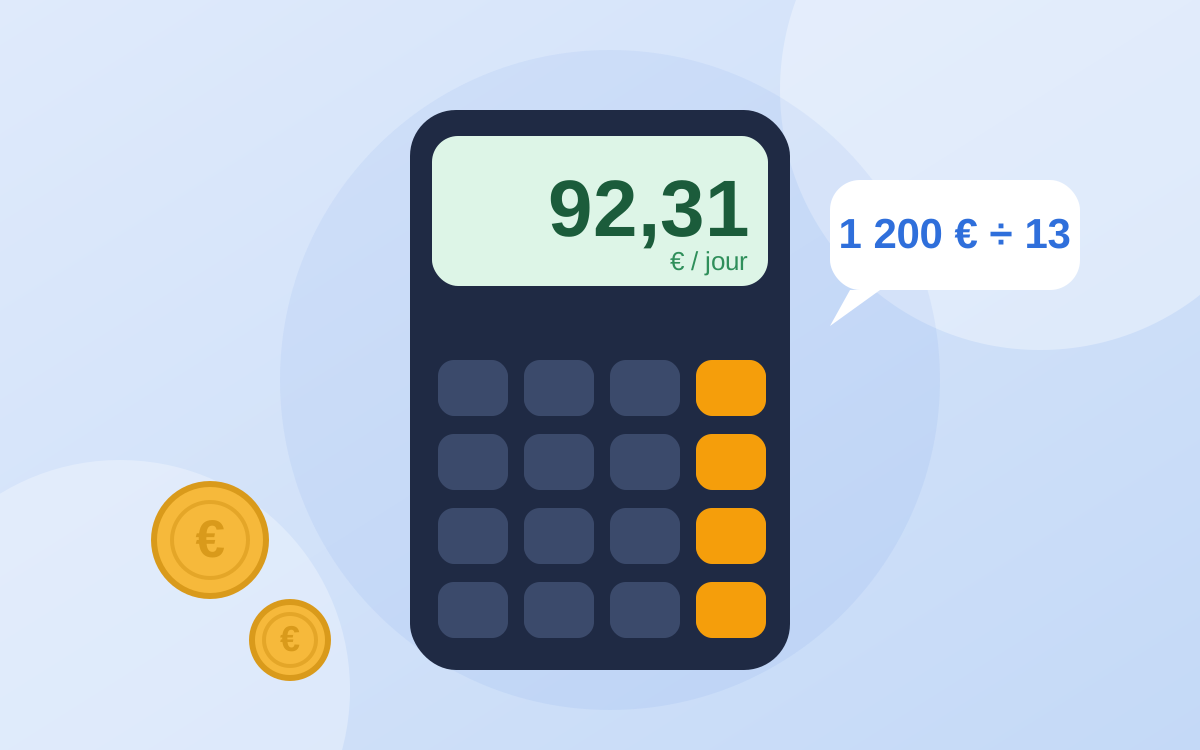
A single figure for the whole month stays abstract. Divide what’s left by the number of days until your next payday and you get a concrete guide for each day. The calculation is detailed in the article on how much you can spend per day.
The most common mistakes
- Forgetting yearly costs (insurance, taxes, gifts, holidays).
- Not recording small expenses: a coffee, a delivery, a forgotten subscription.
- Aiming for a budget that’s too strict: people give up after two weeks. Keep some room for surprises.
- Not updating it when your income or bills change.
What about the 50/30/20 rule?
Splitting 50% for needs, 30% for wants and 20% for savings is a popular guideline, handy for a first estimate. It isn’t a universal rule: with high rent or a small income, those proportions can be unrealistic. Always start from your real numbers.
What Pockeo does for you
Pockeo follows these steps for you: you enter your income, your fixed bills and your savings, and the app works out how much you can spend today, recalculated with every expense, starting from your payday rather than the 1st of the month. There’s no dashboard to set up for an hour, and no link to your bank.
Sources
- Insee — Gross disposable income and purchasing power, quarterly data (published 28/08/2026, in French)
- Insee — Portrait social 2023, “Dépenses pré-engagées” (in French)
In the interest of transparency: this article was written by Pockeo, the publisher of the app. The figures quoted come from the sources listed at the bottom of the page; the Pockeo features described are those of the app at the time of publication. This content is general information, not personalised financial or legal advice.