In short. To find your daily amount: take your income, subtract fixed bills and savings, add any extra income, subtract what you’ve already spent, then divide what’s left by the days until your next payday.
The formula
(income − fixed bills − savings + extra income − already spent) ÷ days left = today’s amount
Each term answers a simple question: how much came in, how much is already committed, how much you want to put aside, how much you’ve already spent, and how many days you still have to cover.
A worked example
- Pay for the cycle: €2,400
- Fixed bills (rent, subscriptions, utilities): €812
- Savings: €150
- Extra income (a refund): €120
- Already spent since payday: €358
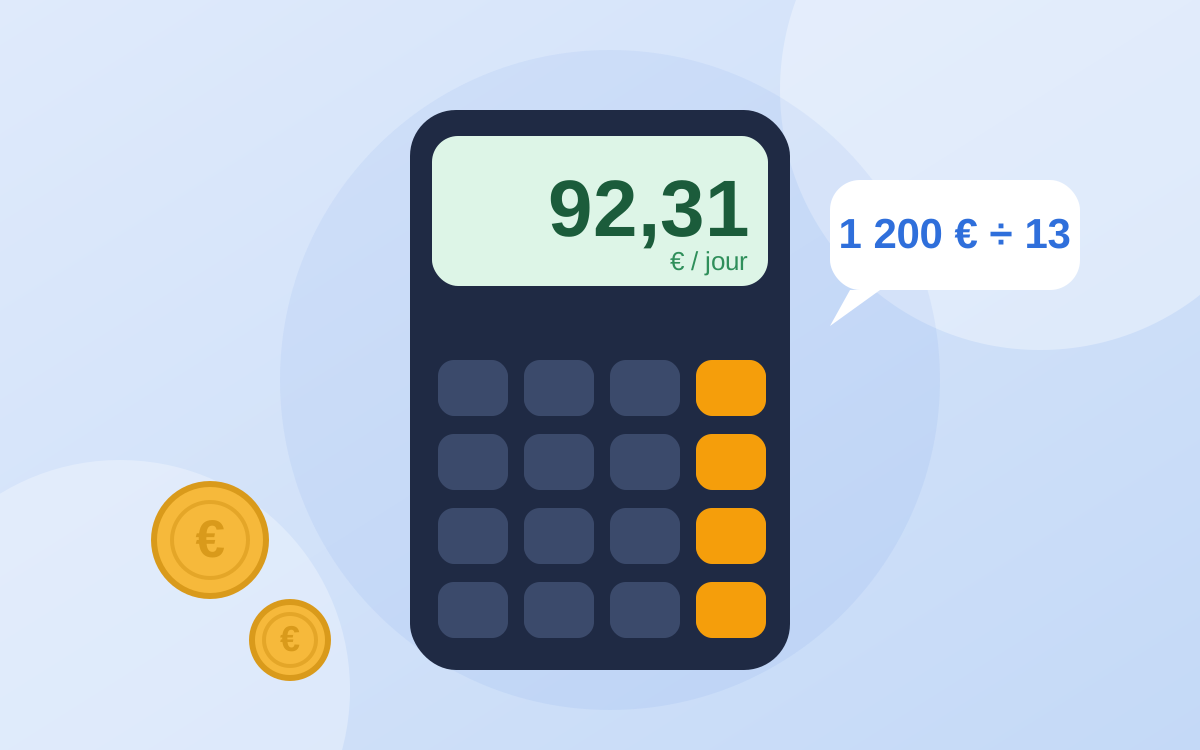
Left for the cycle: 2,400 − 812 − 150 + 120 − 358 = €1,200. With 13 days to go until the next payday, today’s amount is 1,200 ÷ 13 = €92.31.
Why start from payday?
The 1st of the month means nothing special to your bank account: what counts is the day the money arrives. Counting from payday to payday, you know exactly how many days your income has to cover, and the calculation stays right even if you’re paid on the 20th or the 28th.
Daily budget or rolling budget?
- Daily: each morning starts from a fresh amount. What you don’t spend is spread across the remaining days.
- Rolling: what you don’t spend one day stays available on the following days, leaving room for a night out or a bigger grocery run.
Neither is better in itself: the first gives more structure, the second more flexibility. Pick the one you’ll actually stick to.
What if my income changes from month to month?
Simply update the income for the cycle when it changes: everything else is recalculated. If your income varies a lot, start from a cautious estimate and add the surplus as “extra income” when it arrives.
Pitfalls to avoid
- Forgetting a yearly cost: it lowers today’s amount all at once.
- Counting savings as spendable money: if they’re part of the plan, take them out first.
- Not recording an expense: today’s amount becomes wrong, and you don’t know it.
Calculating it automatically with Pockeo
This is exactly the calculation Pockeo does: you enter income, fixed bills and savings, and the app shows the amount available today, recalculated with every expense you add. Where many tools simply show you what has already happened, Pockeo gives you an amount to stick to from this morning. If you haven’t laid out your numbers yet, start with the article on organizing your budget.
In the interest of transparency: this article was written by Pockeo, the publisher of the app. The figures quoted come from the sources listed at the bottom of the page; the Pockeo features described are those of the app at the time of publication. This content is general information, not personalised financial or legal advice.